
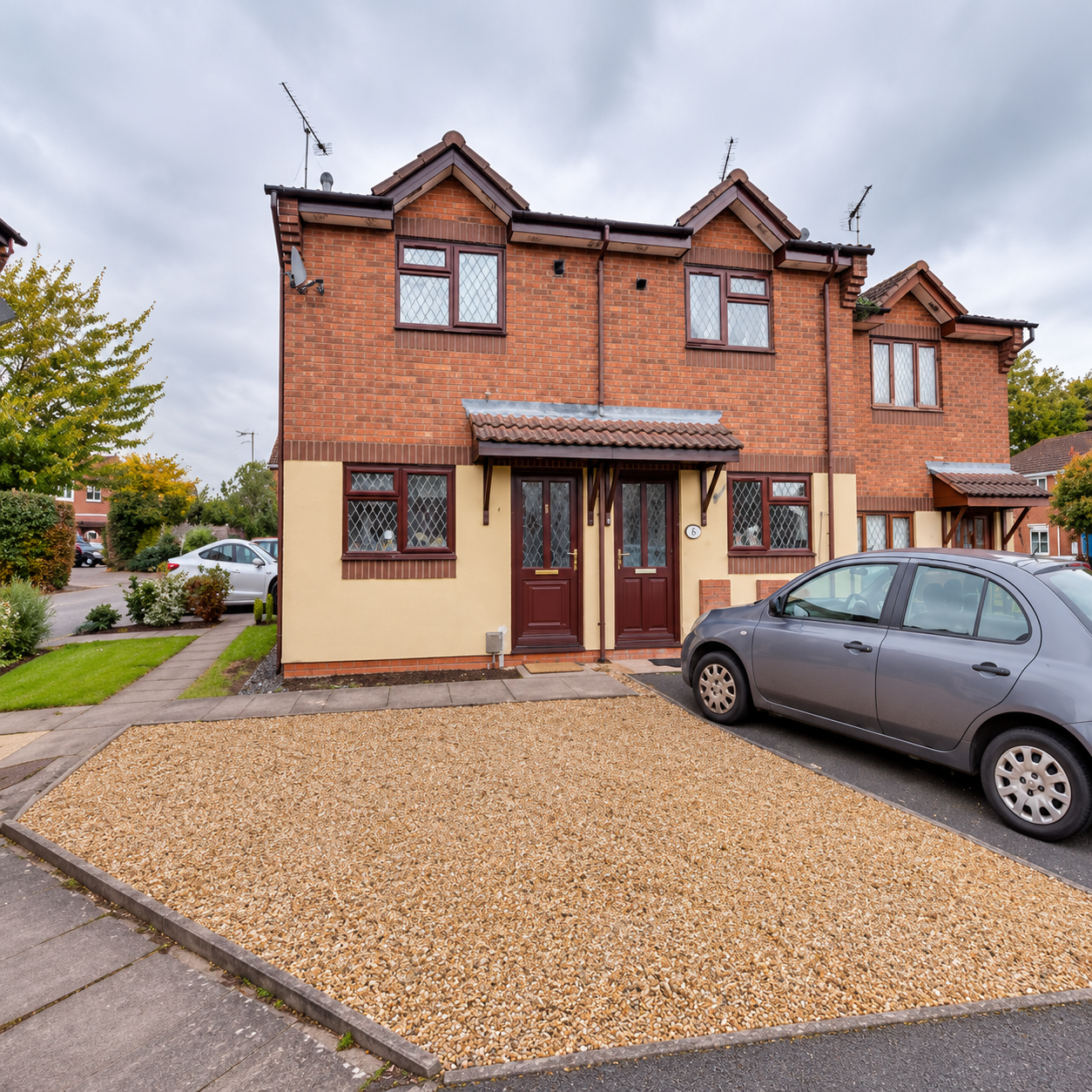
I bought my first house when I was 19, the thumbnail to his article is that very same house.
It sounds wonderfully financially responsible.
It wasn't.
I was a university drop-out who had just started as a school-leaver trainee accountant. I wasn't earning loads of money (about the equivalent of $14,000!) and I didn't have an investment strategy- I barely had a plan.
The UK in 2000 was a very different lending environment, you could get a 105% mortgage and banks would manage the risk by only lending two-and-a-half times your income.
So teenage me bought a house and wiewed from the outside, I probably looked like I was doing pretty well with money.
Then came my first Christmas in that house, which was much less than tinsel and cake. I was 20 and on the phone to the bank asking them to extend my overdraft because I didn't have enough money to get through Christmas.
I rang them twice and they said no both times. So I went cap in handto my family for food.
I owned a house. I worked in accounting. And I didn't have enough financial buffer to get through Christmas without help.
That memory comes back to me quite a lot now, because I'm not sure the things we use as evidence that someone is “good with money” actually tell us very much at all.
A few years later, I remember arguing with a car dealer about how the interest on my car finance was being calculated.
By this point I was an accountant and I understood numbers. I was so very sure I was right.
I was completely wrong. Not slightly wrong. Properly wrong.
The car dealer understood that particular bit of consumer finance better than I did, while I was busy explaining to him why he was mistaken.
It's more than slightly painful in hindsight, but also quite useful.
Qualifications, professional confidence and knowing financial jargon can make someone look financially literate but my own story demonstrates that it doesn't mean you understand every financial decision in front of you.
At 27, while I was on maternity leave, we ended up living partly off a credit card- and not because 'Accounting Sasha' had carefully decided that revolving credit was the optimum financing structure for parental leave.
We just hadn't really planned well enough for the drop in income. I'm embarrassed to admit that we sold one of our cars and used the money to clear the credit card.
Again, that can sound impressively responsible if I tell youthe story the right way: Recognised debt. Sold asset. Repaid debt.
Except there's another rather important bit.....y husband at the time happened to be offered a leased car through work.
Thank God.
Because suddenly we could sell our car without needing to buy another one.
That was just luck, and I think we need to talk about luck more when we talk about money.
There is an assumption I' completely unconvinced by that's buried fairly deeply in financial services that people with more money probably understand money better.
I think that having more money gives you more margin for error, and a higher income can absorb a bad decision.
Assets can give you options and family can provide a safety net.
An employer suddenly offering you a car can turn a difficult financial situation into a manageable one.
None of those things necessarily tells us how financially capable someone is.
Meanwhile, someone who has spent years stretching every dollar might know exactly what happens to their money.
They know which bill can move by three days, which one absolutely can't.
How much petrol gets them to payday, and what food will stretch across another two dinners.
When the school costs are going to land and what gets paid first when there isn't enough money to pay everything.
Whilst that might not be sitting beautifully inside an Excel spreadsheet or use fancy financial jargon, I'd say it's a much clerer example of financial knowledge.
In fact, some of the most sophisticated financial decision-making I've seen comes from people with the least room to get it wrong.
It's important that I don't turn this into a charming collection of Sasha's youthful financial disasters without acknowledging that I'm grateful to have had options.
When the bank said no to extending my overdraft, I had family I could go to for food.
When we needed to repay the credit card, we had a car we could sell and circumstance gave us another way to get around.
Later in my life, I owned a home with enough equity and borrowing capacity to create other choices.
There's a heap of privilege in that and I think it's important to name it because otherwise it's very easy to look backwards at someone's financial life and turn circumstance into skill.
Lets be honest- my decisions were a mixture of good, bad, lucky, and terrible. I also had choices that other people wouldn't have had.
Years later, when I left Avanti Finance to start Money Sweetspot, I didn't have several years of living costs sitting neatly in a founder emergency fund.
There was no colour-coded spreadsheet entitled: SASHA'S EXTREMELY RESPONSIBLE TRANSITION INTO ENTREPRENEURSHIP.
I had enough capacity in my mortgage to borrow against my home and use that money to live while I tried to build a business and a long-suffering (and encouraging) husband.
Then lockdown happened and, completely unintentionally, we spent less money than we otherwise would have.
It worked, but again it wasn't really planning, it was circumstance.
Debt gave me an option that I was fortunate enough to have. That doesn't make debt inherently good or bad, but the context for the debt does.
And that's probably one of the biggest things building Money Sweetspot has changed in how I think about money.
I didn't expect that building a business around helping people get out of debt would make me examine my own relationship with money quite so much.
I'm not going to pretend I now I track every cent and have achieved financial enlightenment.
But, I think partly due to the 10,000 stories we have now listened to, I think much more now about capacity.
I work on creating a little space before I need it and have small savings pockets now.
Money goes into different places for things that future Sasha is fairly predictably going to need.
They're not enormous amounts and there's nothing particularly revolutionary about them.
Just little, wonderfully boring, really useful pockets. Rather than financial resilience being created through one heroic financial decision, it can be built in baby steps, in vaguely the right direction. Not perfect, not always, but sometimes it's just £20 here, $50 there, quietly giving your future self a few more choices.
The other thing I've noticed is my son. He's 18 and he's genuinely pretty good with money- better than me and his Dad!
I don't think that's because I've delivered a comprehensive financial education programme to him but money and debt have just been talked about.
I also say the phrase "Every choice has a consequence." in our house alot. That can include talking about what things cost and what else you could do with that money or spending your weekend with your mates instead of studying. He's also seen the journey of his Mum's career- the ups and downs, and the many false starts and lessons of Money Sweetspot. He's definitely absorbed some of it.
That's why I think financial capability is less something you're taught once and more something you keep developing through your whole life.
Through information, conversations, mistakes, life happening, a dose of luck, and occasionally being confidently corrected by a car dealer.
Financial education can too easily begin with an assumption: Here is what you don't know. Let us teach you.
I'm not sure that's always the right starting point, and it's one of the reasons that our education isn't a step by step proramme.
Somebody might not know the technical definition of compound interest and still be astonishingly skilled at keeping a household functioning on a tiny amount of money.
Someone else might understand investment terminology beautifully and still be routinely making financial decisions they haven't really thought through.
I have, at various points, been that second person. So maybe the questions need to be different.
I think that's a much more useful conversation than deciding whether somebody is “good” or “bad” with money.
I know a lot more about money now than I did at 19.
Thankfully.
But I also understand much better how much financial outcomes are shaped by the choices available to us.
I think we need to acknowledge that much more, particularly when we're designing financial products, education and support for people whose margins are much smaller.
The purpose of financial education shouldn't be teaching everyone to behave like the people who already have money, it should be helping people build on what they already know, add knowledge where it's useful and create more capacity for choices.
I've learned plenty about money from accounting qualifications and working in financial services but I've probably learned just as much from the overdraft that got declined, the credit card we had to clear, the car dealer I incorrectly argued with, and the decisions I've made since.
Turns out financial literacy is a lifelong project, even when you're the CEO of a company that talks about money all day.

%20(1200%20x%201200%20px).gif)

You are protected by responsible lending laws. Because of these protections, the recommendations given to you about our loan products are not regulated financial advice. This means that duties and requirements imposed on people who give financial advice do not apply to these recommendations. This includes a duty to comply with a code of conduct and a requirement to be licensed. Responsible lending criteria, rates, fees and contract terms apply. For more information visit useful information.
© 2026 Money Sweet Spot Limited


