
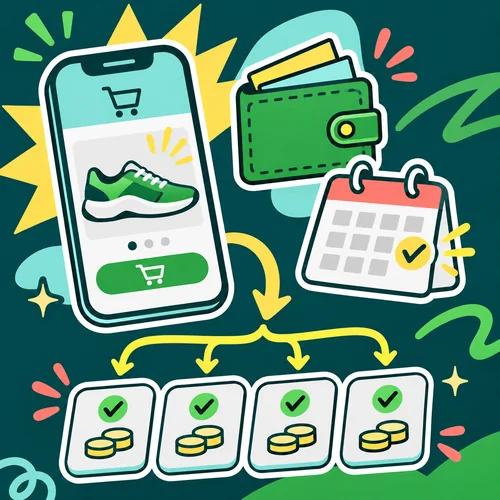
A $200 purchase can feel rather different when the checkout tells you it's four payments of $50.
Four small numbers. No interest, perhaps. A lovely new pair of shoes. What's not to like?
Well, possibly your next four paydays, which have already committed themselves to rent, groceries, power and that car registration you keep forgetting about. Buy now, pay later (BNPL) can be genuinely useful. It can spread the cost of something you've already decided to buy, and some arrangements don't charge interest if you pay on time. We're not here to declare that everyone using it is making terrible decisions. Money is for living, too.
But there's a useful difference between choosing how to pay for something and deciding to buy it because the payments look small.
You don't need to conduct a full financial audit every time you buy socks. But a quick look at those four questions can save an awkward conversation with future you.
Imagine your washing machine has finally given up. You've planned to replace it, found the one you want for $400 and already have the money set aside.
Choosing four $100 interest-free payments might be a considered way to manage cash flow, provided you understand the terms and keep the money available. The payment arrangement isn't what convinced you to buy the washing machine.
Now imagine spotting a $400 gadget you weren't planning to buy. Suddenly it appears to cost just $100 today. That can feel much easier to say yes to, even though you're still committing to $400.
Neither example tells us everything about whether the purchase is right for you. The distinction is simply whether the smaller number is helping you pay or persuading you to spend.
Here's where the maths becomes interesting.
You buy something for $120, another item for $200 and then a third for $160. If each purchase is split into four equal instalments, that might mean payments of $30, $50 and $40.
Together, that's $120 due whenever those instalments line up.
You didn't make one $480 purchase. You made three decisions that added up to the same commitment.
This is why looking at a single provider's balance isn't always enough; payments may fall on different days, across different providers, and at the same time as ordinary bills.
Some arrangements have different repayment schedules, so check the actual due dates rather than assuming everything will be nicely spaced out.
A BNPL account might show that you can spend up to a particular amount. That's information about the service, not a promise that your household can comfortably afford to use it.
Imagine you're paid $1,200 fortnightly. After housing, groceries, transport and other essential commitments, you have $300 available. If $180 of BNPL instalments also falls due, that leaves $120 before anything unexpected happens. That's not necessarily a disaster. It's just a very different picture from the one shown on the checkout screen.
A useful habit is to look at your next two or three paydays before adding another purchase. What is already due? What will be left afterwards? And is there enough room for ordinary life to happen?
Sales can make instalment payments feel even more appealing. You're shown a discount off the original price, followed by a smaller amount to pay today. Two very persuasive numbers in one shopping cart.
A sale can be a great time to buy something already on your list. But a discount is only useful if the final price works for your finances. If you've saved money on a planned purchase, brilliant. You could put the difference towards savings, debt repayment or something else you value.
If the item wasn't on your list, you haven't automatically 'saved' the difference between the advertised original price and the sale price. You might simply have bought something new, which can still be fine, so long as you're making that decision deliberately.
Buy now, pay later is a form of credit, even if the arrangement doesn't normally charge interest. Missed payments can attract fees, and payment behaviour or credit checks may affect your credit information depending on the provider and arrangement.
In New Zealand, BNPL became subject to consumer-credit protections from September 2024, with some specific exemptions. That does not mean every provider has to make the same affordability assessment a personal-loan lender would make. It's worth reading the actual terms rather than assuming all payment services work alike.
Check the total amount, fees, repayment dates and what happens if you miss a payment before using the service. If your circumstances change and a repayment is going to be difficult, contact the provider early to discuss your options.
Here's a small experiment if you've got several purchases on the go: when an instalment plan finishes, don't immediately replace it with another one.
Notice what becomes available in your next payday. Perhaps you can put that amount into a savings pocket, make an extra debt repayment or leave yourself a little more breathing room.
For example, if a completed plan frees up $40 a fortnight, that's money you can give a new job instead of automatically using it for the next purchase.
BNPL doesn't have to be an endless relay race where one set of payments hands the baton straight to another.
Buy now, pay later can be useful when it's a deliberate payment choice, rather than a reason to spend.
Your future paydays will probably appreciate being consulted. Especially if they'd otherwise still be paying for something you've forgotten you bought.

You are protected by responsible lending laws. Because of these protections, the recommendations given to you about our loan products are not regulated financial advice. This means that duties and requirements imposed on people who give financial advice do not apply to these recommendations. This includes a duty to comply with a code of conduct and a requirement to be licensed. Responsible lending criteria, rates, fees and contract terms apply. For more information visit useful information.
© 2026 Money Sweet Spot Limited


